ここから本文です
TWO:[See larger version]

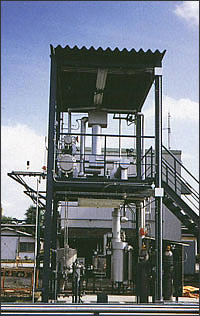
Membrane separation type solvent dehydration system

Great attention is recently being paid to global environmental issues, and it is now conceivable that companies will need to treat used solvents themselves. In consideration of this kind of social issue, we have developed a “membrane separation type solvent dehydration system,” which uses a polyimide membrane with superior dehydration properties developed by Ube Industries, Ltd. in combination with our own distillation and concentration technology that has resulted in solvents being more easily recovered.

THREE:The minute subdivision of land which placed the population in a state of such complete dependence upon the potato was first encouraged by the landlords, in order to multiply the number of voters, and increase their Parliamentary interest; but subsequently, as the population increased, it became in a great measure the work of the people themselves. The possession of land afforded the only certain means of subsistence, and a farm was therefore divided among the sons of the family, each one, as he was marriedwhich happened earlyreceiving some share, and each daughter also often getting a slice as her marriage-portion. In vain were clauses against subletting inserted in leases; in vain was the erection of new houses prohibited; in vain did the landlord threaten the tenant. The latter relied upon the sympathy of his class to prevent ejectment, and on his own ingenuity to defeat the other impediments to his favourite mode of providing for his family. This process was at length carried to an extreme that became perfectly ludicrous. Instead of each sub-tenant or assignee of a portion of the farm receiving his holding in one compact lot, he obtained a part of each particular quality of land, so that his tenement consisted of a number of scattered patches, each too small to be separately fenced, and exposed to the constant depredations of his neighbours' cattle, thus affording a fruitful source of quarrels, and utterly preventing the possibility of any improved system of husbandry. These small patches, however, were not numerous enough to afford "potato gardens" for the still increasing population, and hence arose the conacre system, by which those who occupied no land were enabled to grow potatoes for themselves. Tempted by the high rent, which varied from 8 to 14 an acre without manure, the farmers gave to the cottiers in their neighbourhood the use of their land merely for the potato crop, generally a quarter of an Irish acre to each. On this the cottier put all the manure he could make by his pig, or the children could scrape off the road during the year, and "planted" his crop of potatoes, which he relied upon as almost the sole support of his family. On it he also fed the pig, which paid the rent, or procured clothes and other necessaries if he had been permitted to pay the rent with his own labour. The labourer thus became a commercial speculator in potatoes. He mortgaged his labour for part of the ensuing year for the rent of his field. If his speculation proved successful, he was able to replace his capital, to fatten his pig, and to support himself and his family, while he cleared off his debt to the farmer. If it failed, his former savings were gone, his heap of manure had been expended to no purpose, and he had lost the means of rendering his pig fit for the market. But his debt to the farmer still remained, and the scanty wages which he could earn at some periods of the year were reduced, not only by the increased number of persons looking for work, but also by the diminished ability of the farmers to employ them. Speculation in potatoes, whether on a large or small scale, had always been hazardous in the southern and westerly portions of Ireland. There had been famines from the failure of that crop at various times, and a remarkably severe one in 1822, when Parliament voted 300,000 for public works and other relief purposes, and subscriptions were raised to the amount of 310,000, of which 44,000 was collected in Ireland. In 1831 violent storms and continual rain brought on another failure of the potato crop in the west of Ireland, particularly along the coast of Galway, Mayo, and Donegal. On this occasion the English public, with ready sympathy, again came forward, and subscriptions were raised, amounting to about[537] 75,000. On several other occasions subsequently, the Government found it necessary to advance money for the relief of Irish misery, invariably occasioned by the failure of the potatoes, and followed by distress and disease. The public and the Legislature had therefore repeated warnings of the danger of having millions of people dependent for existence upon so precarious a crop.
  • 1Under the distillation system, even in case of azeotropic solvent compositions, this system which remove water vapor by the polyimide membrane will easily dehydrate.
  • 2In comparison with the distillation system, it significantly saves on use of steam.
  • 3Dehydration can be performed through merely supplying evaporated vapor to the membrane module and maintaining the differential pressure between the permeable side and the impermeable side.
  • 4Solvent purity of 99.9% or more can be achieved by carrying out dehydration with a polyimide membrane only.
  • 5The polyimide membrane has superior heat and solvent resistance. Therefore, the vapor permeation system reduces contamination of the membrane and thus extends its life.
THREE:St. Clair had marched with such celerity that he reached, before the next night, Castleton, thirty miles from Ticonderoga. But the rear division under Colonel Warner halted at Hubberton, six miles short of Castleton. Early next morning, General Fraser found them on a hill. No sooner did they descry him, than one of the regiments turned and fled, leaving most of their officers to be taken prisoners. But the other two regiments, commanded by Warner and Francis, stood their ground stoutly. Fraser had with him only about eight hundred men, and the Americans were from one thousand two hundred to one thousand five hundred strong. But Fraser advanced up the hill and attacked them briskly. The Americans were protected by a sort of breastwork formed of logs and trees, and they gave Fraser a smart reception. But, calculating on the approach of Reisedel and the Germans, he fought on; and Reisedel soon after marching up with a full band of music, the Americans imagined that the whole body of the Germans was there, and fled on to Castleton as fast as they could.During this protracted agony of suspense and alarm business was almost at a standstill. Nobody seemed to think or talk of anything but the rebellionthe chances of success and the possibility of having to submit to a republic. There could not be a more striking proof of the inability of Lord Clarendon to cope with this emergency than his dealings with the proprietors of the World, a journal with a weekly circulation of only 500 or 600 copies, which subsisted by levying blackmail for suppressing attacks on private character. It was regarded as a common nuisance, and yet the Lord-Lieutenant took the editor into his confidence, held private conferences with him on the state of the country, and gave him large sums for writing articles in defence of law and order. These sums amounted to 1,700, and he afterwards gave him 2,000 to stop an action in the Court of Queen's Bench. Mr. Birch, the gentleman in question, was not satisfied with this liberal remuneration for his services; the mine was too rich not to be worked out, and he afterwards brought an action against Sir William Somerville, then Chief Secretary, for some thousands more, when Lord Clarendon himself was produced as a witness, and admitted the foregoing facts. The decision of the court was against Birch; but when, in February, 1852, the subject was brought before the House of Commons by Lord Naas, the Clarendon and Birch transactions were sanctioned by a majority of 92.

The aromatic polyimide membrane is highly permeable to water vapor but less permeable to vapors of organic compounds such as alcohol etc.

THREE:The measure, which was founded on the recommendations of the report, was advocated principally by Lord John Russell, Lord Melbourne, and Mr. C. Hobhouse. The plan was intended to provide for 183 corporations, extending to a population of at least 2,000,000. Many of these corporations governed large and important towns, of which they did not sufficiently represent the property, intelligence, and population. In Bedford the corporation composed only one in seventy of the people, and one-fortieth of the property. In Oxford there were only 1,400 electors, and seldom more than 500 voted at an election. In Norwich 315 of the electors were paupers. In Cambridge there were only 118 freemen, out of a population of 20,000; and while the annual rental was more than 25,000, the property of freemen amounted to little more than 2,000. These were only samples of the strange anomalies that everywhere prevailed. It was obvious to every one that corporations so constituted were altogether unfitted for the objects which they were originally designed to answer. On the contrary, they tended directly to frustrate those objects, and to render the proper government of towns impracticable. They engendered jealousy and distrust between the small governing power and the body of the people. A few persons carrying on the government for their own benefit were connected with a portion of the lower classes, whose votes they purchased and whose habits they demoralised. With such a monopoly the grossest abuses were inevitable. Charitable funds, often large in amount, which had been left for the benefit of the whole people, were either lavishly distributed among the venal dependents of the governing body, squandered on civic feasts, or spent in bribing the freemen in order to secure their votes. In short, the general if not the universal practice had been to use the powers of municipal corporations, not for the good government or benefit of the towns over which they presidednot in order that they might be well and quietly governed in the terms of the charters, but for the sole purpose of establishing an interest which might be useful in the election of members of Parliament.
  • 1 Recovery of the detergent solvent Recovery of the cleaning solvent such as electronic parts industry, precision instrument industry.
  • 2Solvent recovery and the refinement Solvent recovery and the refinement such as chemical industry, an industry of medical supplies, food industry, the fermentation industry.
THREE:WILLIAM IV.

Acetone, ethanol, methyl ethyl ketone, butanol, isopropyl alcohol, ethyl acetate, methyl isobutyl ketone, others (including hexane and toluene).